


World

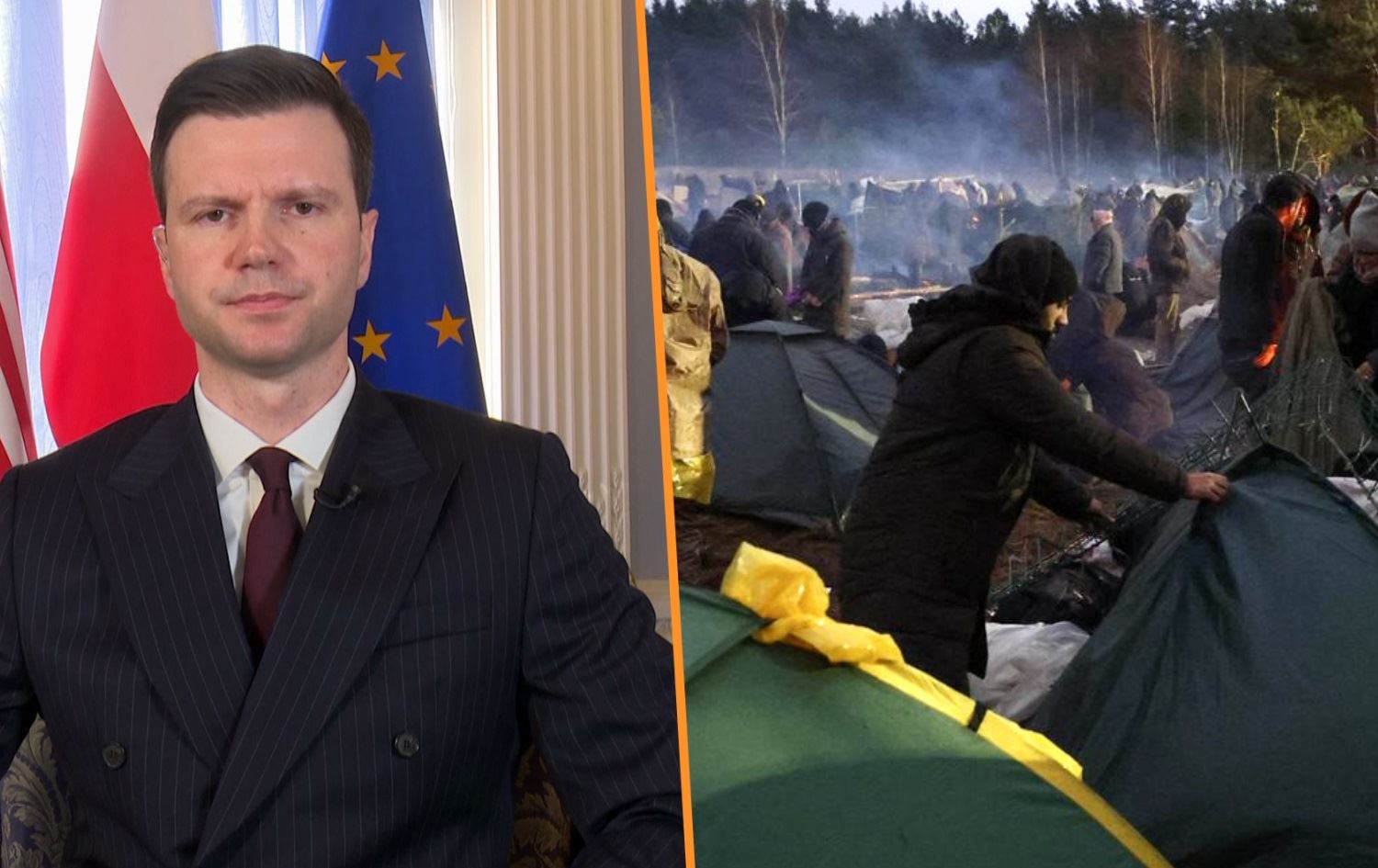
Adam Krzywosądzki interviewed by Rudaw, and migrants gathering at the checkpoint "Kuznitsa" on the Belarus-Poland border near Grodno, Belarus, both on November 18, 2021. Photo: Rudaw / Maxim Guchek / BelTA via AP
ERBIL, Kurdistan Region - Migrants on the Belarus-Poland border are being deliberately weaponised by Alexander Lukashenko's regime, a Polish diplomat told Rudaw on Thursday, stressing his country’s tough stance against allowing migrants to enter Poland, and warning that the solution to the crisis requires "a serious change in the behavior of the Belarusian regime."
Adam Krzywosądzki, the Polish chargé d'affaires, told Rudaw’s Shahyan Tahseen from Washington DC that "the situation on the Polish-Belarusian border is still very dire… there are about 4,000 people in the border area on the Belarusian side, and about 20,000 in different places across the country [in Belarus]."
According to a statement published by the Kurdistan Regional Government (KRG) on Thursday, there are currently over 20,000 migrants stuck on the borders of Belarus, Poland and Lithuania; the same number of servicemen deployed along the Polish border, across the border-force, police, and army, Krzywosądzki told Tahseen.
"We have taken robust steps in order to secure our border," Krzywosądzki said on the strengthening of Poland’s border infrastructure. "We already have A-class capabilities when it comes to securing our border, including the best technology in the world, and very skilled border-guards. But given the gravity of the current challenge, the decision was also taken to reinforce the infrastructure with a barrier fence that would be enough to stem this flow of illegal migrants."
Migrants, the diplomat explained, are "being helped by Belarusian services who bring them all sorts of weaponry which they can use to cross the border."
When pressed on what more Poland should be doing to resolve the crisis, he placed the solution entirely with Minsk.
"The answer to your question lies with Lukashenko, one of the last dictators in Europe. This is a man-made crisis orchestrated from the beginning to the end by the Lukashenko regime."
The diplomatic tensions with Belarus were evident, and Krzywosądzki stressed the support that Poland has received from the US. "We are strengthening cooperation with our allies on both sides of the Atlantic, including here in the United States. We have very close coordination with the EU, also with NATO, and first and foremost here in Washington DC with our American allies."
US Secretary of State Anthony Blinken and Poland’s Minister of Foreign Affairs Zbigniew Rau agreed on the need for "diplomatic outreach to different countries in the Middle East that are unfortunately a source of migrants that come to Belarus, and who are being treated by the regime in a very malign manner" in a recent telephone call, he said.
"We also need to strengthen sanctions against the Belarusian regime. The European Union and its foreign ministers have taken a very important decision in this regard just this Monday, and the United States is to follow suit on this matter," Krzywosądzki continued.
Asked whether Poland could benefit from the knowledge and experience of the US in dealing with the issue of migrants on their border with Mexico, Krzywosądzki drew comparisons with the importance of both borders, but made a distinction between the levels of violence.
"One thing that we surely have in common is the fact that our borders are very important ones and the US southern border obviously, is subject to significant migratory pressure. The Polish eastern and northern borders are the borders of the European Union and the Schengen area; the visa free zone of the European Union."
"Since 2004, when we joined the European Union, we have taken significant steps in order to strengthen our capabilities at the border," he said.
"When it comes to the nature of the challenges that we are faced with, however, we have to bear in mind that these are two totally different situations. In the case of Poland, we are dealing with a dictatorial regime that forces people who it has deceived to forcibly cross the border to Poland", Krzywosądzki commented, making the point that there were cases of "physically pushing and beating people in order to force them to cross the border to Poland."
Over 400 Iraqi and Kurdish migrants who had been stuck on the Belarus-Poland border voluntarily returned on Thursday, in a flight provided by the KRG and Iraqi authorities.
According to the Belarus state news agency BelTA, Lukashenko proposed to German Chancellor Angela Merkel that the EU could open a humanitarian corridor to allow 2,000 migrants to head to Germany.
Lukashenko’s press secretary Natalya Eismont told BelTA that, “Merkel agreed to discuss this proposal with the EU, including a possibility to arrange a humanitarian corridor to Germany.”
In response to a request for comment from AP, Merkel’s office referred to its statement on the call between her and Lukashenko on Tuesday, in which she stressed the need for the migrants’ safe return home, and urgent humanitarian assistance.
The prime minister of Poland Mateusz Morawiecki discussed the migrant crisis in two separate telephone calls on Thursday evening with the prime minister of the KRG, Masrour Barzani, and the prime minister of Iraq, Mustafa al-Kadhimi.
In a statement released after the conversations, Morawiecki said he told Barzani and Kadhimi that Minsk is using their people to “threaten the security of Poland and the EU,” in the nature of a hybrid war, and that “Citizens of Iraq, including those from Kurdistan, are being used for this war.”
“Our humanitarian aid has been blocked by the Belarusian side for several weeks,” he added.


Comments
Rudaw moderates all comments submitted on our website. We welcome comments which are relevant to the article and encourage further discussion about the issues that matter to you. We also welcome constructive criticism about Rudaw.
To be approved for publication, however, your comments must meet our community guidelines.
We will not tolerate the following: profanity, threats, personal attacks, vulgarity, abuse (such as sexism, racism, homophobia or xenophobia), or commercial or personal promotion.
Comments that do not meet our guidelines will be rejected. Comments are not edited – they are either approved or rejected.
Post a comment